
Most fintech landing pages fall into one of two traps. They’re either thin paid-media destinations that evaporate the moment ad spend stops, or bloated service pages trying to rank for everything while converting nobody. Both miss the point.
Fintech landing page SEO copywriting is the practice of building a standalone page to rank for one intent cluster and move one cautious visitor toward one action. Fintech changes that job fundamentally. Compliance constraints shape your copy. Buyer skepticism demands proof most industries never have to provide. The trust bar is higher, the regulatory margin tighter, and the penalty for getting it wrong more expensive than your competitors seem to realise.
What follows is a nine-part methodology built at the intersection of organic performance, conversion architecture, and regulatory reality.
1. Define What a Fintech SEO Landing Page Actually Is (and What It Isn’t)
The term “landing page” gets applied to at least four different page types, and the confusion costs real money. Teams build the wrong format for the wrong channel, then wonder why rankings stall or conversion rates flatline.
Here’s the working definition: a fintech SEO landing page is a standalone page engineered to rank organically for a specific intent cluster and convert that organic visitor toward a single action. One audience segment, one promise, one offer, one primary CTA.
It is not a PPC landing page (stripped of navigation, designed for paid traffic, invisible to crawlers). It is not your homepage (serving brand awareness across multiple audiences). And it is not a service page (cataloguing everything you offer under a broad category heading).
Each format has its place:
- PPC landing pages work for time-sensitive campaigns: limited offers, A/B tested ad funnels, demo requests tied to a specific paid keyword.
- Homepages orient new visitors and distribute traffic across your site architecture.
- Service pages explain capability breadth for visitors already exploring your brand.
- SEO landing pages capture organic intent at the moment someone searches “open a business checking account” or “compare invoice financing rates.”
The distinction matters because each format follows different rules for structure, navigation, internal linking, and content depth. Trying to make one page do all four jobs produces a page that does none of them well. For pages focused on explaining your product capabilities in depth, Fintech product page SEO copywriting follows its own set of structural and conversion principles.
The operating guardrail: one persona, one promise, one offer, one primary CTA. If you find yourself writing for two different buyer profiles or hedging between “Start a Free Trial” and “Schedule a Demo,” you don’t have a landing page problem. You have a segmentation problem. Split the page. Two focused pages will outperform one conflicted page every time.
2. Map Keywords to Conversion Intent Before You Write a Word
Most fintech teams run keyword research and conversion planning as separate workstreams. The SEO analyst builds a keyword list. The copywriter drafts a page. The product marketer defines the offer. Then everyone wonders why the page ranks for terms that don’t convert, or converts visitors who came looking for something else entirely.
The fix is a simple mapping rule: one primary keyword cluster aligns with one offer, one buyer stage, and one action. Before a single headline gets drafted, those four elements need to agree. If they don’t, you’re building a page with a structural fracture no amount of copy polish will repair.
Start with the Language Your Buyers Already Use
The best keyword research for fintech doesn’t start in a keyword tool. It starts in sales call transcripts, support tickets, app store reviews, and Reddit threads where prospects describe problems in their own words.
A product marketer might call it “automated accounts receivable.” Your prospect types “how to get invoices paid faster without chasing clients.” That second phrase is longer, more specific, and far more likely to match the intent of someone ready to act. Voice-of-customer language reveals the long-tail, intent-specific phrases that broad vanity terms obscure. Those phrases also carry less competition and higher conversion potential, precisely because competitors are chasing the two-word head terms.
The Keyword-to-Page Alignment Checklist
Once you’ve identified your primary cluster, every visible element on the page needs to reinforce the same intent:
| Page Element | Alignment Question |
|---|---|
| Title tag | Does it contain the primary phrase and signal the specific value proposition? |
| Meta description | Does it reflect the searcher’s language and set an accurate expectation? |
| H1 and hero message | Do they immediately confirm the visitor found what they searched for? |
| Body copy | Does it address secondary questions, objections, and trust concerns this buyer stage demands? |
| Supporting entities | Are related terms (competitor names, regulatory bodies, product categories) woven in naturally? |
| Trust cues | Are compliance badges, testimonials, or data points placed where hesitation is most likely? |
| Primary CTA | Does the action match the intent? (Informational visitors want a guide, not a sales call.) |
If any row conflicts with the others, the page isn’t ready to draft. A title tag promising rate comparisons on a page that pitches a demo creates a message mismatch Google’s algorithm can detect and your visitors will punish with a back button.
3. Structure the Page Anatomy for Both Scanners and Scrollers
You have roughly three seconds above the fold to answer the only questions a fintech visitor actually cares about: What is this? Is it for me? Why should I believe you? Miss any one of those and the back button does the rest.
The anatomy of a high-performing fintech landing page follows a specific sequence, each section building on the last to layer clarity, credibility, and motivation in the order skeptical financial buyers actually process information.
Hero Statement and Supporting Subhead
The H1 locks the keyword match and states the outcome in plain language. Not your internal product name. The specific result the visitor searched for, reflected back at them. The subhead expands with one qualifying detail: who this is for, what makes it different, or what proof supports the claim. Together, these two lines function as a contract that earns or loses the scroll.
Trust Proof Block
Before you’ve asked the visitor to read anything substantial, place your strongest trust signals: regulatory badges (FDIC, FCA, SOC 2), recognisable client logos, or a single data point that’s difficult to fake (“$2.1B processed in 2024”). This block lowers the psychological barrier before real attention is invested. Without it, everything that follows gets filtered through unresolved skepticism.
Problem Agitation and Solution Framing
Now you’ve earned enough trust to name the pain. Articulate the exact operational headache that drove the search query. Then reframe your product as the resolution. This section does the heaviest persuasion work on the page because it proves you understand the visitor’s reality before you’ve described a single feature.
Feature-to-Benefit Translation
For every capability you mention, the copy should complete the sentence “which means you…” A real-time API connection is a feature. Reconciliation that takes minutes instead of days is the benefit a finance director cares about. Structure this as scannable blocks so visitors can locate the benefit most relevant to their situation without reading sequentially.
Objection Handling
Every fintech buyer carries a shortlist of reasons not to act: implementation complexity, switching costs, security concerns. Addressing these proactively signals confidence. Burying them in an FAQ footer signals avoidance. Place objection handling in the main body, framed as clarifications rather than defensive responses.
CTA and Final Proof Block
The primary call to action appears here with one supporting piece of evidence: a testimonial from someone in the visitor’s role, a concrete outcome metric, or a risk-reduction element (“no contract, cancel anytime”). This resolves last-second hesitation without reopening the decision loop.
Keeping the Structure Honest
On longer pages, repeat both proof elements and the CTA. A visitor who scrolls past the hero-level trust block shouldn’t have to scroll back up to find the action. Place secondary trust cues and CTA buttons at natural decision points throughout the page.
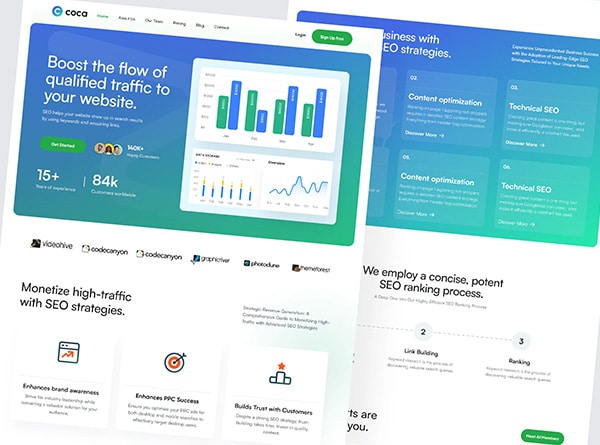
Use visuals that show your actual product. A clean screenshot of your dashboard or a partial view of a real report gives the visitor something concrete to evaluate. In fintech, where the product is often invisible (software, APIs, data processing), visual proof of a functioning interface does more for credibility than any paragraph of copy.
4. Write Trust-First Copy That Handles Fintech Objections Head-On
Most fintech landing pages lose the deal in the middle. The structure is fine. The keyword targeting is solid. But somewhere between the hero and the CTA, the copy goes vague. It starts talking about “seamless solutions” and “cutting-edge technology” without answering the questions actually stalling the decision.
Your visitors aren’t bouncing because they lack interest. They’re bouncing because the page didn’t resolve their hesitation.
The Four Objections That Stall Fintech Conversions
Fintech buyers carry a predictable set of concerns, and most trace back to risk. The page that names these concerns and resolves them with evidence converts. The page that talks around them doesn’t.
- Fees and pricing clarity. Vague pricing language (“competitive rates,” “flexible plans”) triggers suspicion in financial buyers who’ve been trained to hunt for hidden fees. State the pricing model. If it’s complex, explain the structure. If you can’t publish exact numbers, explain why and tell them what happens next to get a quote.
- Security and privacy. A padlock icon in the footer isn’t enough. Visitors need specific language: encryption standards, compliance certifications, data residency, who has access to what.
- Onboarding friction. This is where finance directors silently talk themselves out of acting. If onboarding takes two days, say that. If you offer migration support, describe what it includes. Replace “easy setup” with a timeline and a process.
- Implementation and integration risk. For B2B fintech especially, integration anxiety kills conversions that were otherwise ready to close. Name the platforms you connect with. Describe what a typical integration looks like.
Translating Features Into Business Outcomes
“AI-powered reconciliation engine” is a feature. “Your month-end close drops from five days to one” is the reason someone fills out the form.
Every claim on the page should complete that translation. Instead of “We simplify compliance,” describe what happens: “Our platform flags non-compliant transactions in real time, generates audit-ready reports, and routes exceptions to your compliance team with suggested resolutions.” The specificity is itself a trust signal. It tells the reader you’ve actually built the thing, not just written marketing copy about it.
Where Proof Belongs on the Page
Proof elements lose most of their power when they’re clustered in a testimonial carousel near the bottom. Place them where doubt is highest:
- Near the hero: client logos and a single quantified outcome anchor credibility before the visitor has invested real attention.
- Beside the form or primary CTA: a testimonial with context (name, title, company, specific result) resolves last-second hesitation right where the action happens.
- After objection handling: security certifications and compliance badges placed immediately after you’ve named the risk they address.
A quote from a named CFO describing a specific outcome (“Cut reconciliation time by 70% in the first quarter”) carries weight because it’s verifiable and mirrors the language your prospect uses internally when justifying a decision to leadership. Testimonials without that context read as fabricated. The pattern holds for every proof type: client logos earn more trust with a number attached, security language earns more trust when it names the standard, reviewer credentials earn more trust when they match the visitor’s role. Specificity is the mechanism. Vagueness is what your competitors are offering.
5. Optimise On-Page SEO as a Structural Problem, Not a Keyword Exercise
Adding your target phrase twelve more times won’t move the needle. If the page already matches intent and the copy is strong, what’s holding back rankings is almost always structural: how the page is built, labelled, and signalled to search engines at the code level.
On-page SEO for fintech landing pages is an architecture discipline. Every element performs a specific job in how search engines parse, index, and surface your content.
The Structural Checklist
| On-Page Element | Job It Performs |
|---|---|
| URL slug | Signals topic relevance. Short, descriptive, hyphenated. /invoice-financing-rates not /page?id=4827. |
| Title tag | Primary ranking signal and click-through driver. Core phrase front-loaded where possible. |
| Meta description | Earns the click in SERPs. Reflects the searcher’s language, sets an honest expectation. |
| H1 | Confirms topic match for crawler and visitor. One per page, aligned with the title tag’s promise. |
| H2/H3 hierarchy | Creates passage-level indexing opportunities. Each H2 should answer a distinct sub-question well enough to surface independently in results. |
| Semantic coverage | Related entities (competitor names, regulatory terms, product categories) woven into body copy to demonstrate topical depth, not just keyword presence. |
| Image alt text | Describes what the image shows for accessibility and reinforces relevance for visual search. |
| Indexation directive | Self-referencing canonical tag. No accidental noindex. Confirmed in Search Console. |
Answer-First Intros for Passage Retrieval
Google’s passage ranking means individual sections can surface independently in search results. Structure each H2 with a concise, answer-first opening sentence that resolves the sub-question before expanding into detail. A visitor or crawler landing mid-page should immediately understand what the section covers without reading anything above it.
Internal Links From Cluster Content
Your landing page doesn’t rank in isolation. Blog posts, comparison guides, and educational content within the same topic cluster should link to the landing page using descriptive anchor text that reinforces the target phrase. Map each supporting article to the specific section it strengthens. A post about regulatory compliance links to the compliance proof section. A comparison guide links to the feature-benefit block. Contextual links pass topical authority exactly where it compounds.
Mobile Readability and Page Speed
Structural SEO collapses if the page loads slowly or renders poorly on a phone. A four-second LCP on mobile doesn’t just hurt rankings. It kills the conversion you worked to earn. Defer non-essential scripts until after main content loads. Keep paragraphs short enough to avoid wall-of-text compression on small screens. Touch targets for CTAs need at least 44×44 pixels of tap space.
These aren’t separate workstreams. A page that loads fast, reads cleanly on any device, and is structured so search engines can parse every section independently is a page that ranks and converts simultaneously. For teams that need end-to-end support across technical and content optimisation, dedicated Fintech SEO services ensure these structural elements are implemented correctly from the start.
6. Build Compliance Into the Writing Brief, Not the Legal Queue
Most teams treat compliance as the final gate before publication. Copy gets written, designed, and nearly shipped before legal redlines it and sends it back for a rewrite that guts the headline and buries the CTA under a paragraph of qualifiers. Timelines slip. The page goes live late, diluted, and satisfying nobody.
The problem isn’t legal being slow. Compliance requirements entered the process too late to be designed around. When regulatory language is retrofitted into finished copy, it reads like exactly what it is: a last-minute patch.
What the Brief Should Flag From the Start
Your writing brief should identify these constraints at the outline stage, not the review stage:
- Unsupported performance claims. Any reference to returns, savings, or speed needs a substantiation plan before the first draft. “Save up to 40% on processing fees” requires the dataset behind it. If the data doesn’t exist, the claim doesn’t make the brief.
- Guarantees and absolutes. Words like “guaranteed,” “zero risk,” and “no fees” carry regulatory weight in financial services. Flag them as requiring evidence or rewrite them out.
- Vague superlatives. “Best-in-class” and “industry-leading” are claims without a comparison framework. Regulators and sophisticated buyers both read them as hollow.
- Security and regulatory references. Mentioning SOC 2, PCI DSS, or FDIC authorization isn’t decoration. Each carries verification requirements scoped to specific products, and the copy needs to reflect that scope accurately.
Placement Matters as Much as Language
- Disclosures near the claim. A rate mentioned in the hero needs its qualifier within the same visual field, not a footnote three scrolls down. Regulators evaluate the net impression a reasonable person takes away.
- Privacy language near the form. If you’re collecting personal data, the explanation of what and why should be visible at the point of collection. Not linked from a global footer. Adjacent to the form.
- Testimonial substantiation. A customer quote claiming “70% faster reconciliation” requires documentation. If a result is atypical, say so where the quote appears.
A Review Workflow That Doesn’t Stall
Structure the process in three passes to keep legal focused on what genuinely requires legal judgment:
- SEO and copy draft with claim notes. The writer flags every claim, data point, and regulatory reference inline.
- Product and compliance review. The product team verifies accuracy. Compliance reviews flagged claims against current requirements. Both happen on annotated copy, not finished designs.
- Final legal signoff. Legal reviews only the claims and disclosures needing formal approval, not headline phrasing or body copy.
This structure compresses review cycles because each reviewer sees only what’s relevant to their expertise. The copy was written within compliance boundaries rather than edited into them after the fact. Pages ship faster, and the finished product reads like cohesive communication rather than a marketing message with regulatory scar tissue.
7. Structure the Page for AI Search Extractability
A useful rule of thumb: if an AI model can’t quote your answer cleanly, the section is probably too vague to rank well in traditional search either.
Generative search experiences (Google’s AI Overviews, Perplexity, Bing Chat) pull answers from pages that present information in discrete, quotable units. A fintech landing page built exclusively for human persuasion, with narrative paragraphs that never state a concrete fact, becomes invisible to these systems. They skip past it because there’s nothing clean to extract.
This doesn’t mean rewriting your page as a Wikipedia article. It means adding structural elements that give retrieval models something to grab while your persuasive architecture stays intact.
Question-Led Subheads and Direct-Answer Openings
Restructure at least a portion of your H2/H3 hierarchy around the questions your buyers actually ask. “How does invoice financing work?” as a subhead, followed by a two-sentence direct answer in the opening paragraph, gives both AI models and passage-ranking algorithms a clean extraction point. The detail and proof that follows can be as rich as the topic demands. But the answer comes first.
Each section should function like a self-contained response that makes sense without surrounding context. A crawler pulling just that paragraph should get a complete, accurate thought.
Entity-Rich Wording and Crawlable HTML
Vague copy is invisible to retrieval systems. “Our platform helps with compliance” gives a model nothing to index. “Our platform generates SOC 2 audit reports and flags PCI DSS exceptions in real time” gives it three named entities and two specific capabilities. Use proper nouns, regulatory acronyms, product category names, and measurable specifics wherever the copy allows.
Keep the HTML clean too. Information trapped inside JavaScript-rendered tabs, accordion toggles requiring a click to expand, or content loaded dynamically via AJAX may never get crawled. If a fact matters enough to appear on the page, it should be present in the initial HTML source.
Extractable Modules Worth Adding
Layer in content blocks designed specifically for retrieval without disrupting the conversion flow:
- FAQ section with schema markup. Three to five questions reflecting real search queries, each answered in two to three sentences. FAQPage schema increases the chance of surfacing in AI-generated responses.
- Short definition blocks. A one-sentence definition of your core product category (“Invoice financing is a form of short-term borrowing where outstanding invoices serve as collateral”) gives models a clean snippet to cite.
- Original frameworks or checklists. A named evaluation framework or concise checklist becomes a referenceable asset. Models prefer summarising structured, original thinking over paraphrasing generic advice.
The goal isn’t choosing between persuasion and extractability. A clear, entity-rich answer to a real question is persuasive to a human and extractable by a machine. The fintech brands designing for retrieval from the start are building pages that compound across every surface where answers appear.
8. Surround the Landing Page With a Supporting Content Cluster
A fintech landing page sitting alone on your domain is a page working against itself. It might rank briefly on the strength of its on-page signals, but without surrounding content reinforcing its authority, it loses ground to competitors whose pages are backed by an entire ecosystem of related assets.
Search engines evaluate topical authority at the domain level, not just the page level. A single page targeting “business checking account” carries far less weight when it’s the only content on your site touching that subject. Add a comparison page, a glossary entry defining operating account terminology, an FAQ cluster covering fee structures, a case study showing how a specific business used the account, and a compliance page detailing FDIC coverage, and the picture changes entirely. That landing page now sits inside a visible support system that both crawlers and visitors can see.
How Internal Links Should Route
The cluster works because the linking logic follows a deliberate pattern:
- Awareness content routes to the landing page. A blog post explaining “how to choose a business banking partner” links naturally to the landing page where that decision can happen. Educational articles and comparison guides send visitors who are ready to act.
- The landing page routes to proof and deeper explanation. Visitors who need more evidence before converting find contextual links to case studies, annotated product examples, and compliance documentation. These links resolve hesitation without cluttering the conversion path.
Each supporting asset builds topical relevance that lifts the landing page’s organic authority. Each inbound link from the cluster passes contextual signals. And each outbound link to proof assets keeps hesitant visitors inside your ecosystem instead of sending them back to search.
Why This Compounds
A visitor who reads a comparison page, checks a glossary term, runs a scenario through your calculator, and then arrives at the CTA has pre-qualified themselves through your content. They reach the conversion point with fewer objections and higher confidence. The cluster doesn’t just strengthen SEO signals. It accelerates lead readiness.
The fintech brands that treat each landing page as the centre of a small content ecosystem are the ones building organic authority that compounds quarter over quarter. Dedicated Fintech blog SEO writing services can accelerate that ecosystem by producing the educational and comparison assets your landing pages need for cluster support.
9. Measure What Matters, Then Test What You Measure
Raw form fills tell you almost nothing. A page generating 200 leads a month looks healthy until sales reports that 180 are unqualified, wrong segment, or just hunting for a free resource. The measurement model for a fintech landing page needs to distinguish vanity metrics from performance metrics before any optimisation begins.
KPIs Worth Tracking
- Qualified organic traffic. The subset arriving through your target intent cluster, filtered by geography and landing path. A spike from irrelevant queries inflates reports without moving revenue.
- Non-branded keyword rankings. Branded searches mean someone already knows you. Non-branded rankings measure whether the page captures new demand from prospects still evaluating options.
- Form completion rate. The percentage who start the form and finish it. A gap between form views and submissions signals friction in the form itself, not a traffic problem.
- Conversion rate by traffic source. Organic, referral, and cluster-sourced visitors convert at different rates. Blending them into one number hides where the page actually performs.
- Assisted conversions. Many visitors don’t convert on the first visit. This data reveals which cluster pages and proof assets do pre-qualification work before the visitor reaches the CTA.
- Proof-section engagement. Scroll depth and click-through on testimonials, case studies, and security badges. If visitors consistently skip the proof block, it’s misplaced or unconvincing.
- Sales feedback on lead quality. The metric no dashboard captures automatically. A monthly review of which leads progressed and which didn’t calibrates every upstream decision.
What to Test (and How to Protect What’s Regulated)
Prioritise experiments targeting the specific stage where visitors drop off:
- Headlines. Outcome-specific versus feature-specific. “Cut your month-end close to one day” versus “AI-powered reconciliation platform” reveals which framing earns the scroll.
- Proof placement. Client logos above the fold versus below the problem-agitation section. Where proof sits changes when trust registers.
- CTA wording. “Get a Custom Quote” versus “See Pricing” versus “Start Free Trial” each imply different commitment levels. Match the language to the buyer stage the page serves.
- Form friction. Fewer fields lifts completion rates, but removing a qualifying question can flood sales with unfit leads. Test deliberately.
- Objection sections. Lead with security if visitors bounce before the feature block. Lead with pricing transparency if abandonment spikes at the commitment point.
- Section order. Heatmaps and scroll data reveal where attention drops. Reorganise accordingly.
Run controlled experiments on one variable at a time so results stay interpretable. One critical guardrail: document every claim-sensitive element (disclosures, rate references, compliance badges) before testing on a regulated page. A variant that repositions a required disclosure isn’t a design experiment. It’s a compliance event.
The model that works here values learning over volume. A page converting fewer leads at higher quality, with sales confirming that quality, outperforms a high-volume page generating pipeline that never closes.
How to Build a Fintech Landing Page: A Five-Step Production Workflow
The nine dimensions above give you the strategic framework. This section turns that framework into a repeatable workflow your team or agency partner can run, from blank brief to live page. If you’re evaluating external support for this process, core Fintech SEO copywriting services provide the foundational expertise to execute each step effectively.
Before starting, five things need to be in place. Without any one of them, the workflow stalls or produces a page requiring a costly rebuild.
- Offer positioning. A single, clearly defined offer mapped to one buyer segment and one action (established in Sections 1 and 2).
- Approved proof assets. Testimonials, client logos, data points, and certifications cleared for use. Hunting for these mid-draft is where most timelines collapse.
- Keyword research. A primary cluster and supporting entities mapped to conversion intent, not a raw keyword dump from a tool.
- Analytics access. Search Console, your analytics platform, and heatmap tooling configured on the target URL path before launch.
- A named compliance owner. One person with authority to approve claims, disclosures, and regulatory references. Not “the legal team.” A specific individual with a response SLA.
Step 1: Discovery and Claims Inventory
Audit every performance claim, data point, and regulatory reference the page might include. Pull from product documentation, sales decks, and existing collateral. For each claim, document the substantiation source and flag anything lacking evidence. If a number can’t be verified, it doesn’t make it to the brief. This inventory becomes the single reference document your writer, product team, and compliance owner all work from.
Step 2: Build the Keyword-to-Section Brief and Wireframe
Using the intent-mapping approach from Section 2, assign each H2 section a specific sub-question, a target keyword cluster, and the proof element that belongs there. The wireframe doesn’t need to be pixel-perfect. It needs to sequence the page anatomy (Section 3) and mark where compliance-sensitive claims sit relative to their disclosures (Section 6). By the end of this step, every stakeholder should see the page’s argument laid out visually before a single sentence is drafted.
Step 3: Draft Copy With SEO, UX, and Compliance Notes in One Document
Produce a single annotated draft. Inline notes flag every claim against the inventory from Step 1, mark where structured data and extractable modules belong (Section 7), and indicate disclosure placement. This eliminates the back-and-forth that happens when SEO notes live in a spreadsheet, compliance flags live in an email thread, and UX feedback lives in a design tool.
Step 4: Product, Sales, and Compliance Review in Limited Rounds
Route the annotated draft through three reviewers in sequence, not in parallel. Product verifies accuracy. Sales confirms the objection handling (Section 4) reflects real buyer conversations. Compliance reviews only the flagged claims and disclosure placements. Cap this at two revision rounds. A thorough brief and wireframe mean the draft should arrive close to final.
Step 5: Publish, QA, Link Supporting Assets, and Launch the Test Plan
Before the page goes live, verify indexation directives, structured data, mobile rendering, and page speed (Section 5). Connect the supporting content cluster (Section 8) by placing contextual internal links from existing assets. On launch day, confirm the measurement framework from Section 9 is capturing qualified traffic, form completion rate, and proof-section engagement. Define your first A/B test based on whichever conversion stage shows the weakest baseline data.
The outcome of this workflow is two deliverables: an approval-ready fintech landing page and a reusable scorecard. The scorecard documents every decision made across these five steps, so the next page your team builds starts from a proven template rather than a blank screen. That repeatability is where the real efficiency compounds. Landing pages are one component of a broader Fintech website SEO copywriting strategy that aligns every page on your domain toward organic growth.
Frequently Asked Questions
How much do fintech audience research services usually cost?
Most credible firms scope custom statements of work rather than publishing fixed rates, because the variables shift the budget dramatically. Directional ranges run from $25,000 for a focused discovery sprint to $150,000 or more for a multi-method program that includes quantitative validation. The biggest price drivers are recruitment difficulty (executive panels and underbanked fieldwork cost significantly more than general consumer panels), geographic spread, method complexity, and whether the scope includes quant survey validation on top of qualitative findings. Those first two variables, recruiting senior B2B stakeholders and reaching underserved populations, tend to move the budget fastest.
How long should a good fintech audience research project take?
A credible engagement typically runs six to twelve weeks, covering stakeholder alignment, screener development, recruitment, fieldwork, synthesis, and a structured readout. A fast discovery sprint (qualitative interviews with a defined segment) can land in six weeks. Fuller programs involving segmentation, quantitative validation, or multi-market recruitment need the longer runway. Compressing below six weeks usually means cutting corners on recruitment quality or synthesis depth, both of which undermine the entire investment.
What deliverables should I expect from a serious partner?
At minimum: validated personas, a segmentation matrix with priority scoring, journey maps tied to real behavioral data, trust and messaging findings, feature or benefit prioritization outputs, raw data or session clips for internal review, and an implementation roadmap connecting each finding to a business metric. The critical test is whether the deliverables help product, marketing, and leadership make specific decisions. If the final output summarizes interviews without telling anyone what to do differently, the research hasn’t finished its job.
Should we do this in-house or work with a specialist partner?
Internal teams win at continuous listening, existing product analytics, and institutional context. A specialist wins where recruitment is hard (senior executives, underbanked populations), where neutral synthesis prevents internal politics from filtering findings, where cross-functional alignment needs an outside voice to hold, and where compliance-sensitive study design requires specific expertise. The best outcomes usually blend both. The right partner feels like an extension of the team rather than a vendor managing a handoff, which is exactly the model Urban Geko brings to research-to-execution engagements.