
You want WordPress because it works. Fast to publish, easy to update, and your marketing team can actually use it without filing a dev ticket every time a headline needs changing.
But you’re in finance. And finance doesn’t forgive a site that feels lightweight, loads slow, or handles sensitive data like an afterthought. Your prospects are evaluating your credibility before they ever speak to anyone on your team, and a cookie-cutter WordPress build signals exactly the wrong thing.
Fintech WordPress development can absolutely meet the bar. Getting there requires seven deliberate decisions covering scope, security, themes, plugins, payments, client portals, and publishing governance. The kind of build where brand, development, and long-term support work as one system, not three separate vendor relationships.
1. Define What WordPress Should (and Shouldn’t) Handle
WordPress can do a lot. That’s precisely why it’s worth deciding early what it should do for your financial services site, and where to draw the line.
The platform is a strong fit for your marketing layer: product pages, lead generation forms, thought leadership content, gated resources, calculators, FAQ sections, and a financial blog your team can update without waiting on a developer queue. For campaign landing pages, investor relations pages, and educational resource centres, WordPress gives marketing direct control over publishing velocity. That independence matters when compliance windows are tight and market conditions shift fast.
Where it gets risky is when teams start improvising. Ledger logic stuffed into custom post types. Sensitive customer data stored in the WordPress database. KYC workflows duct-taped together with form plugins. Transaction processing routed through a CMS that was never designed to be a secure application layer. These aren’t theoretical mistakes. They happen when the boundary between “marketing site” and “financial product” never gets clearly defined at the start of a build.
The practical split looks like this:
WordPress handles acquisition and education. Product marketing, SEO content, lead capture, compliance-friendly landing pages, and the public-facing brand experience. Everything your marketing and content teams need to move quickly without creating security exposure.
A dedicated application layer handles the secure product experience. Authenticated banking logic, payment vaults, account dashboards, KYC verification engines, and any workflow touching regulated customer data. These belong in purpose-built infrastructure with its own security architecture. Getting this layer right often demands specialized fintech backend development expertise that prioritizes security, scalability, and regulatory compliance from the foundation up.
A smaller fintech running this split well might use WordPress for every touchpoint before the login screen (acquisition, onboarding content, rate comparisons, educational guides) while the authenticated product experience lives in a separate application entirely. The user never notices the seam. The brand feels cohesive across both environments because the UX, visual identity, and messaging were mapped as one system before either layer was built.
That upfront mapping is where most builds either succeed or generate expensive rework six months later. Getting the boundary right requires a partner who thinks across brand, UX, and technical architecture simultaneously, not a team that starts coding before the scope is settled.
2. Build the Security Stack Before Anything Else
If your hosting, access control, and recovery planning are weak, everything above them is fragile. A beautifully branded WordPress site for a financial services company means nothing if the infrastructure underneath it can’t survive scrutiny. Security isn’t a phase you add after launch. It’s the foundation the entire build sits on.
Your prospects understand this intuitively. They work in finance. They know what a secure operation looks like, and they can sense when one is missing. A site that loads over an unsecured connection or goes down without explanation doesn’t just lose traffic. It loses credibility that’s genuinely difficult to recover.
Hosting and Recovery
Managed WordPress hosting is the baseline for any financial services build. Not shared hosting with an SSL certificate bolted on. A managed environment where SSL/TLS encryption, daily automated backups, staging environments, and malware scanning are part of the standard infrastructure, not add-ons your team has to remember to configure.
The piece most teams overlook is the documented recovery path. Backups are only useful if someone has tested the restoration process and knows exactly how long it takes. When a financial services site goes offline, the question from leadership isn’t “do we have backups?” It’s “how fast can we be back?” If nobody can answer that with a specific number, the recovery plan doesn’t actually exist yet.
Access and Authentication
A WAF and CDN protection form the perimeter. Two-factor authentication and enforced strong password policies protect the interior. But the layer most financial services WordPress sites neglect is role-based access control and regular user-access reviews.
Every account should have the minimum permissions necessary for its role. Writers don’t need admin access. Former contractors shouldn’t still have logins. Quarterly reviews that audit who can do what, and remove accounts that shouldn’t exist, are a simple discipline that prevents the kind of exposure that keeps compliance teams up at night.
The Discipline Layer
Security isn’t a project with a finish date. It’s an operating rhythm.
Prompt updates to WordPress core, themes, and plugins close known vulnerabilities before they’re exploited. Unused plugins and themes should be removed entirely, not just deactivated, because dormant code is still attackable code. Uptime monitoring ensures you know about problems before your clients do. Audit logging gives you the forensic trail regulators expect.
This is where maintaining a secure fintech WordPress build gets honest: marketing teams are built to create and publish, not to monitor security patches and run access audits. Keeping publishing momentum high while ensuring nothing drifts on the security side is exactly where an ongoing partnership with a team that understands both worlds pays for itself, not just at launch, but every month after it.
3. Choose a Custom WordPress Theme Built for Financial Services
A generic WordPress theme can get a site live quickly. Whether it should is a different question entirely.
Off-the-shelf themes serve the widest possible range of businesses. They ship with features most fintech companies don’t need and lack the ones they do. Unused scripts, redundant layout options, and third-party integrations baked into the core slow page loads and expand the attack surface for no benefit. Worse, they make your brand look interchangeable. A prospect scanning three competitor sites built on the same popular theme registers sameness before they register a single word of your messaging.
Financial services sites carry structural requirements generic themes aren’t designed around. Where does the compliance disclosure sit relative to the product claim? Is there clean space for trust modules and regulatory fine print without cramming them into a footer nobody reads? Can the navigation handle the cognitive load of complex financial products without overwhelming a time-pressed decision-maker? These aren’t cosmetic concerns. They’re the visible expression of whether your brand takes its own credibility seriously.
What a Custom Fintech Theme Actually Delivers
A purpose-built theme starts with the problems your audience brings to the page, then engineers the experience around solving them.
Performance means mobile-first, accessible templates engineered to pass Core Web Vitals. Clean code with no unused dependencies. Responsive layouts that maintain hierarchy across devices. Navigation structured for the way financial buyers actually evaluate products: quickly, sceptically, and with one eye on whether this company looks like it knows what it’s doing. These performance standards apply equally across platforms, which is why a holistic approach to fintech web & mobile development ensures consistency whether prospects engage on desktop, tablet, or phone.
Trust means design blocks built specifically for financial credibility:
- Security and compliance sections positioned within the primary visual flow, not buried below the fold.
- Partner and certification logos displayed with enough visual weight to register during a scroll.
- Social proof modules that feel factual rather than promotional.
- Author bios and expert credentials reinforcing E-E-A-T signals for users and search engines.
- FAQ and comparison components that handle financial information density without collapsing into walls of text.
- Calculators and interactive tools integrated natively, not bolted on through third-party embeds that break mobile layouts.
- CTAs designed for consideration, not impulse. “Get Started” with a clear next step converts better than aggressive “Buy Now” language that feels tone-deaf to the decision weight involved.
What This Looks Like on a Page
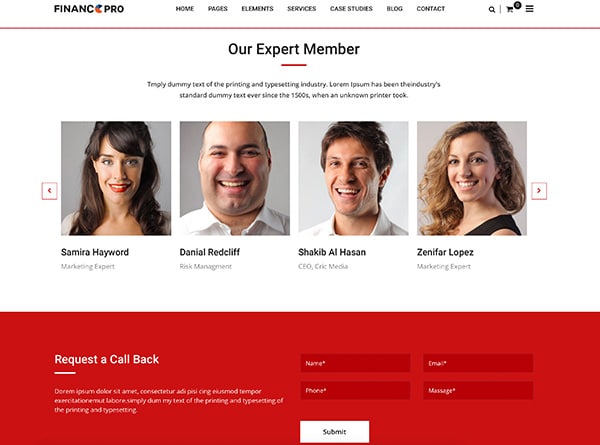
Consider a homepage for a lending or payments company. The hero leads with a clear value proposition and a soft conversion step. Immediately below, a social proof bar: client logos, transaction volume, or a trust metric that grounds the claim. Next, a security and compliance section featuring encryption standards, regulatory affiliations, and audit certifications, visible without scrolling past it. Product features presented as outcomes rather than specifications. An FAQ addressing the objections the prospect is already carrying. The page closes with a low-friction conversion step that feels like a natural next move, not a sales ambush.
Every element does two jobs simultaneously: building credibility and moving the visitor forward. That dual function is what separates a custom fintech theme from a template with your logo dropped in.
This is where the intersection of branding, UX, and development matters most. A team that only handles one of those three will produce a site that looks right but doesn’t perform, or performs but doesn’t feel trustworthy, or functions technically but carries no brand distinction. The build needs all three disciplines working as one system from the start. Applying the principles of fintech frontend development ensures the visual layer performs as well as it looks across every device and interaction point.
4. Treat Plugin Selection Like Vendor Due Diligence
Every plugin you install is a dependency. It comes with an update history, a support track record, a security surface, and a maintainer who may or may not still be paying attention. In financial services, that makes plugin selection a supply-chain decision, not a convenience choice.
Your compliance team wouldn’t approve a third-party data processor without vetting the company behind it. The same logic applies to the code running on your WordPress site. A plugin with 100,000 installs and a five-star rating can still introduce vulnerabilities if the developer has gone quiet, skipped compatibility updates, or started bundling tracking scripts your privacy policy doesn’t account for.
Where Standard Plugins Make Sense
Commodity functions are fair game for well-maintained, widely vetted plugins: SEO management, caching, backup automation, basic security hardening, form handling for non-sensitive data. These are solved problems with mature ecosystems. The vetting criteria are straightforward: active development (updates within the last 90 days), responsive support, compatibility with current WordPress core, and a clean history in vulnerability databases.
For these use cases, building custom would be over-engineering. The maintenance burden of a custom alternative isn’t worth the marginal control it provides.
Where Custom Development Is the Safer Choice
The calculus changes when you’re dealing with functionality specific to your financial services brand. Proprietary calculators with logic your competitors shouldn’t see. Gated resource flows with consent logging that maps to your actual compliance framework. Lead qualification workflows that score and route prospects into your CRM based on financial product fit. API-driven data displays pulling real-time rates or portfolio information.
These are the places where a “close enough” plugin creates hidden debt. You end up working around its limitations, patching gaps with additional plugins, and eventually maintaining a fragile chain of dependencies that nobody fully understands. A disciplined approach to fintech custom plugin development eliminates that fragility by delivering functionality purpose-built for your specific compliance and business requirements.
What Safe Custom Development Looks Like
Custom doesn’t have to mean risky. It means purpose-built, with the same discipline you’d expect from any production system:
- Minimal permissions: the plugin only accesses what it strictly needs.
- Secure input handling: everything validated and sanitized before processing.
- Documented ownership: your team knows exactly what the code does and who maintains it.
- Clean update paths: compatible with WordPress core releases without breaking.
- Maintenance plan: ongoing support that extends well past launch day.
That last point is where most custom builds go sideways. A plugin crafted for your specific needs by a partner who then disappears leaves you with an orphaned build that nobody can safely update. The code itself might be excellent. Without ongoing ownership, it becomes a liability the moment WordPress releases a major update or a new vulnerability surfaces.
This is precisely where the partner relationship matters more than the initial deliverable. A team that builds custom functionality and then owns its ongoing maintenance, keeping it secure, compatible, and evolving alongside your site, eliminates the orphan risk entirely. That continuity is the difference between custom development as a strategic advantage and custom development as a ticking clock.
5. Keep Payment Data Off Your WordPress Server
The instinct when adding payments to a WordPress site is to look for a plugin that “handles payments.” That instinct points in exactly the wrong direction.
For a financial services site accepting consultation deposits, SaaS subscription signups, event registration fees, or any form of checkout, the goal isn’t making WordPress process card data more effectively. It’s ensuring card data never touches your WordPress environment at all.
This distinction matters because the moment sensitive payment information passes through your server, your compliance obligations expand dramatically. PCI DSS scope widens. Your hosting environment needs hardening well beyond what even a well-secured managed WordPress setup provides. The attack surface grows. And the marketing site you built for publishing agility quietly becomes a compliance-heavy application that your content team can no longer update without triggering security review questions.
The Pattern That Works
The practical approach is simpler than most teams expect.
Use a trusted payment gateway’s hosted checkout or hosted payment fields. Stripe Elements, for example, renders card input fields inside iframes controlled entirely by Stripe’s servers. Your WordPress site never sees, stores, or transmits the card number. The gateway captures the sensitive data, vaults it securely on their infrastructure, and passes only a token back through your flow. That token is useless to anyone who intercepts it.
From there, the disciplines are straightforward:
- Protect your webhook endpoints. When the payment gateway sends confirmation data back to your site, those endpoints need signature verification and IP allowlisting. An unprotected webhook is an open door.
- Limit stored payment metadata. Your WordPress database should hold order references and confirmation statuses, not card details or billing addresses that create exposure if the database is compromised.
- Keep marketing pages clean. A landing page promoting a financial product should remain exactly that. The checkout interaction happens in the gateway’s secure environment, not in a WordPress form field.
When the Complexity Grows
This pattern scales comfortably for straightforward payment flows: consultation deposits with a single price point, event tickets, subscription signups with standard billing cycles. These are well-served by hosted checkout solutions sitting alongside a WordPress front end.
Once flows become deeply transactional (recurring billing with usage-based tiers, multi-party settlement, regulatory reporting on payment activity) the architecture needs to evolve. The WordPress marketing layer still handles acquisition and education beautifully, but the payment and product logic belongs in a hardened stack purpose-built for that complexity, coordinated with the front end so the user experience feels seamless.
That kind of cross-functional architecture, where brand, front end, and secure payment infrastructure work as one system, is the collaborative work Urban Geko can guide from strategy through execution. For teams outgrowing traditional CMS constraints entirely, fintech headless cms solutions offer another architectural path that decouples content management from the presentation layer.
6. Design Client Portals That Know Their Boundaries
Most financial services teams hit the same question about halfway through a WordPress build: “Can we put the client portal in here too?”
The honest answer is nuanced, and getting it wrong in either direction costs you. Trying to force WordPress into handling authenticated account management, sensitive document exchange, and privileged financial actions creates security exposure your compliance team will eventually flag. But abandoning WordPress entirely for the portal experience means your marketing team loses control of the branded layer that shapes how clients perceive the whole relationship.
The strongest financial WordPress builds treat the platform as the content and experience layer while keeping identity management and sensitive application logic in dedicated systems. WordPress powers what your team needs to publish, update, and control. The secure infrastructure powers what your clients need to trust.
Two Portal Patterns Worth Understanding
The right architecture depends on what “portal” actually means for your business.
Pattern one: marketing site with a seamless handoff. Your public WordPress site handles the full acquisition journey (product pages, educational content, lead capture, onboarding information) and then hands the authenticated user into a separate application for account access, document management, or transactional functionality. The visual identity, navigation patterns, and brand voice carry across the transition so the user never registers a break. They click “Log In” on your WordPress site and land in a secure environment that looks, feels, and sounds like the same brand.
Pattern two: logged-in resource hub. WordPress itself serves as the authenticated environment, but only for low-risk content that your team controls. Think adviser portals with role-based access to market commentary, partner hubs serving co-branded collateral, or client resource centres populated through API-fed dashboards pulling non-sensitive data. SSO handles authentication. Role-based access controls determine what each user sees. The content lives in WordPress because it changes frequently and your marketing or relationship teams need to manage it without developer intervention.
The critical distinction: WordPress manages the content layer in both. Neither pattern stores privileged account data, processes financial transactions, or handles identity verification inside the CMS.
Where the Boundary Sits
The rule is practical. If a marketing or content professional needs to update it regularly, WordPress is the right home. If it involves account credentials, regulated customer data, or actions with financial consequences, it belongs in purpose-built infrastructure with its own security posture.
What makes the whole thing work is continuity. The user shouldn’t feel like they’re bouncing between two different companies. Typography, colour, voice, interaction patterns: all of it needs to carry across the boundary line. The portal architecture isn’t just a technical decision. It’s a brand decision, a UX decision, and an integration decision, all made together.
This is where having a single partner who can align content strategy, experience design, integration architecture, and governance produces a fundamentally different result than splitting the work across three or four vendors. Each vendor optimises for their piece. Nobody optimises for the seam. And in a financial services portal, the seam is exactly where trust breaks down. A partner experienced in fintech full-stack development can bridge every layer of the build, from front-end experience to back-end integration, so nothing falls through the gaps.
7. Build a Publishing Workflow That Protects What You Publish
A financial blog without publishing governance is a liability wearing a growth hat.
Your resource centre pulls organic traffic and reinforces credibility with prospects already evaluating you. Both functions break if the content isn’t accurate and current. In most industries, a stale blog post is a missed opportunity. In financial services, a stale post quoting last year’s rates or outdated regulatory guidance is a compliance exposure and a trust signal pointing the wrong direction.
The Workflow That Earns Trust
Every piece of financial content should carry a named author with verifiable credentials. Google’s YMYL standards penalise anonymous financial guidance, and your audience is sceptical of content without a face behind it. Pair that with an expert review layer: a compliance officer or subject matter expert who signs off before publication. Not as a bottleneck, but as a checkpoint that catches the claim your writer didn’t realise was time-sensitive.
Build disclosure templates into the CMS itself. Standardised modules for risk warnings, rate disclaimers, and affiliate disclosures that content creators drop into posts without drafting from scratch. Consistent placement, consistent formatting, consistent language. This removes the guesswork that leads to inconsistency, and inconsistency is what regulators look for first.
Approval checkpoints sit at defined stages: draft, compliance review, editorial review, publish. Every touchpoint logged. If a regulator asks who approved a specific claim on a specific date, the answer should take minutes to produce.
Structure That Serves Search and Compliance
A financial blog WordPress setup needs architecture, not just articles. Clear category taxonomy mapping to core product areas. Evergreen explainer hubs building topical authority over time. Comparison pages structured with proper heading hierarchy so search engines and humans can parse them efficiently.
Templates matter here. A well-designed content template makes compliance language readable, positioned within the visual flow rather than buried in a collapsed footer. It standardises where disclosures appear, how author credentials display, and where the “last reviewed” date lives. Your content team publishes faster because the structure is solved. Your compliance team sleeps better because the guardrails are built into the page.
The Maintenance Rhythm That Holds It Together
Publishing is the beginning, not the finish line. Financial content needs a scheduled review cadence: quarterly sweeps verifying that rates, fee structures, and regulatory references still reflect reality. Anything time-sensitive gets flagged with an expiry date in the CMS so it surfaces for review automatically.
Beyond content, the site itself needs ongoing attention: automated daily backups, uptime monitoring, audit logs tracking every change, and quarterly security reviews covering plugins, access permissions, and hosting configuration. A named owner with a defined maintenance schedule. Not “the team” collectively, not “IT when they have time.”
This rhythm is where the value of a long-term partnership becomes visible. Publishing velocity, security posture, content accuracy, and brand consistency all need sustained attention. The partner who built your site and understands your compliance landscape is the same partner positioned to keep it running cleanly month after month, evolving with your business rather than falling quietly out of date.
Frequently Asked Questions
How much do fintech audience research services usually cost?
Most credible firms scope custom statements of work rather than publishing fixed rates, because the variables shift the budget dramatically. Directional ranges run from $25,000 for a focused discovery sprint to $150,000 or more for a multi-method program that includes quantitative validation. The biggest price drivers are recruitment difficulty (executive panels and underbanked fieldwork cost significantly more than general consumer panels), geographic spread, method complexity, and whether the scope includes quant survey validation on top of qualitative findings. Those first two variables, recruiting senior B2B stakeholders and reaching underserved populations, tend to move the budget fastest.
How long should a good fintech audience research project take?
A credible engagement typically runs six to twelve weeks, covering stakeholder alignment, screener development, recruitment, fieldwork, synthesis, and a structured readout. A fast discovery sprint (qualitative interviews with a defined segment) can land in six weeks. Fuller programs involving segmentation, quantitative validation, or multi-market recruitment need the longer runway. Compressing below six weeks usually means cutting corners on recruitment quality or synthesis depth, both of which undermine the entire investment.
What deliverables should I expect from a serious partner?
At minimum: validated personas, a segmentation matrix with priority scoring, journey maps tied to real behavioral data, trust and messaging findings, feature or benefit prioritization outputs, raw data or session clips for internal review, and an implementation roadmap connecting each finding to a business metric. The critical test is whether the deliverables help product, marketing, and leadership make specific decisions. If the final output summarizes interviews without telling anyone what to do differently, the research hasn’t finished its job.
Should we do this in-house or work with a specialist partner?
Internal teams win at continuous listening, existing product analytics, and institutional context. A specialist wins where recruitment is hard (senior executives, underbanked populations), where neutral synthesis prevents internal politics from filtering findings, where cross-functional alignment needs an outside voice to hold, and where compliance-sensitive study design requires specific expertise. The best outcomes usually blend both. The right partner feels like an extension of the team rather than a vendor managing a handoff, which is exactly the model Urban Geko brings to research-to-execution engagements.